
Trip
Odysseus wouldn't have been Odysseus unless he went on the odyssey. Krishna Das
You cross over the threshold. You pass into the unknown, the undiscovered, the strange and the new. You don't know what awaits you there. Whatever it is, you won't return the same person you were before you set out.
A trip explores areas of reality that were previously unknowable.
You can never know all of reality. So what seems obvious, now, is only based on the reality you've exposed yourself to. Dave Gray, the author of Liminal Thinking, lays out the following image. What is obvious to us is based on beliefs, which are based on judgments, which are based on our experiences. When we broaden our experience significantly, we know more reality. Our beliefs become more informed; what is "obvious" expands.1
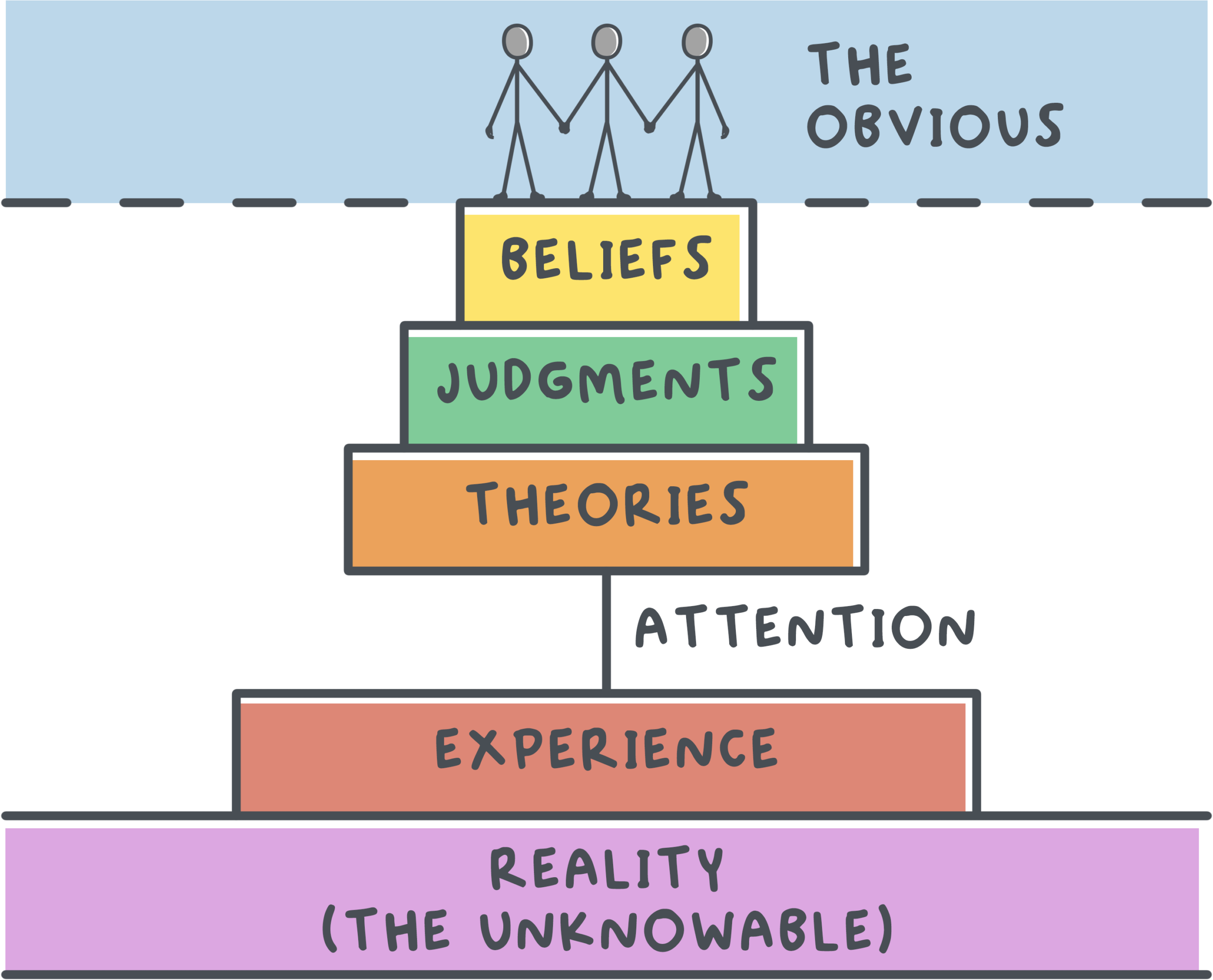
A trip rocks your consciousness into the liminal space beyond the threshold of your normal perception of reality. Liminal thinking changes your understanding to the extent that you do something different to create positive change.
The idea is to get out of your own box, to abandon autopilot for a journey into presence and into the unknown. The hero's journey (popularized by Joseph Campbell) involves a mission or challenge, a breakdown, a breakthrough, an emergence and an evolution of identity.2 To get the habit of Trip, we'll look at ancient mind-altering practices, brainwave states, and plant medicines that promote liminal thinking.
Invision
Shamans, mystics, monks, healers, and holy people go beyond the limited mind using long rituals, chanting, dancing, silence from chatter, fasting for insight. They do this especially at times of crisis or profound questioning; the shaman's trip. The hero goes into the desert for 40 days.
Humans trip for vision, causing what psychedelic thought leader Terence McKenna identifies as "catalysis of imagination." Catalysis is an amplified, accelerated chemical reaction. Humans imagine to solve problems, to create, to understand. Tripping, he says, is the honing of the mind so that when you come down, you see it all differently. We trip for life-altering insights and to upgrade our inner compass (see Purpose).3
We trip for a deeper connection; for perspective, renewal.
Historically, humans responded to seasonal rhythms with rituals to receive life-altering insights, at auspicious and pivotal moments, aligning with nature's cycles. This way, a personal or community pattern was always on schedule to release the past and engage the bigger reality.
Five Mental Afflictions
Patanjali, scribe of the Yoga Sutras in the era before Christ, the master of masters for simplifying the complexity of being human into an action plan for enlightened living, identifies five negative mental tendencies that erode higher-order thinking. In Sanskrit they are called the kleshas, which translates as "afflictions." These five afflictions hold us back and stunt our growth. They are:
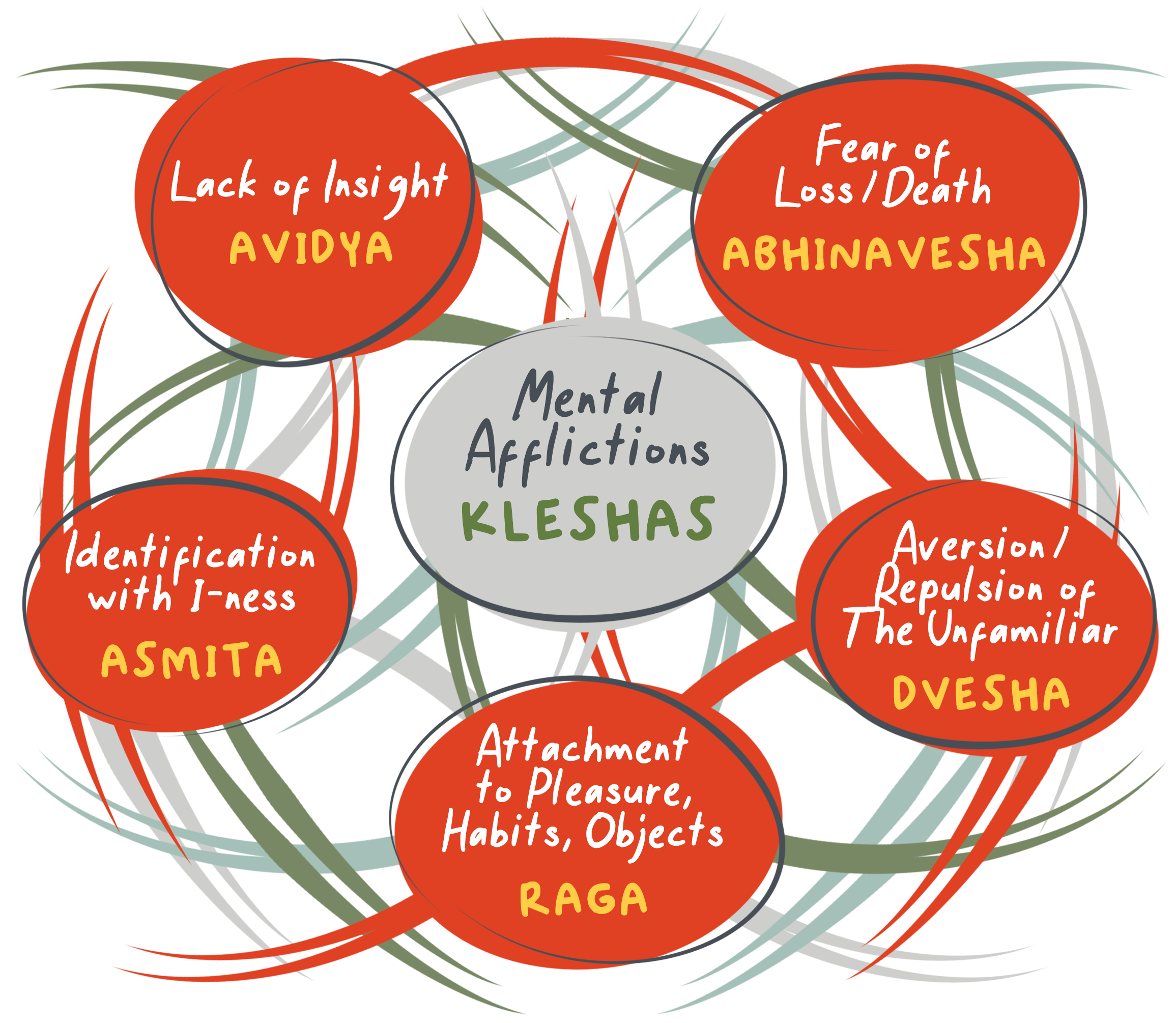
- Lack of insight: misunderstanding of reality
- Over-identifying with one's ego or personality
- Attachment: to temporal pleasures and sticky habits
- Aversion: avoiding what you don't want
- Fearing death
The first affliction, not being in touch with that which is beyond knowing, often called the mystery, is the root of the rest. You can get stuck by not actively learning, growing, receiving feedback, reflecting for insight, or incorporating feedback from your experience and your people. Insight requires quiet reflection and subtle (or not-so-subtle) changes in habits and behaviors. In being receptive to and incorporating insights, you loosen your attachments to past preferences, likes and dislikes, especially those that are working against your health and potential. You loosen the grip on seeing yourself as a fixed personality, or ego, making you more available to your own evolution. You can think of personality or "ego" as the sum total of your habits. With the integration of insight you evolve your habits, your personality. Then, you are less attached or trapped in a past pattern that limits your future potential. When you engage in changes that your intuition is alerting you to, you train yourself to continually evolve your identity, you are available for continual growth and depth. This is the freedom of the awake human being, free of mental affliction.
When you don't incorporate insights, you suffer the same missteps, repeating similar patterns. Opportunities shrink as the future repeats the past.
Fearing death is the stickiest. You need it to survive, but too much of it and you never really live in the first place. Some awareness of the impermanent nature of things (including your physical being) leads, surprisingly, not to despair, but to a clear sense of the preciousness of the present moment, of your next purpose, and an intention to seize the day; carpe diem.
Seeking experiences that expand your relationship with reality, with who you are, and with who you want to be next, is key. In Trip we'll explore the practices and the substances that expand your sense of self.
There are many ways to trip, to rise above the pattern, the limit, the prison of ignorance, fear, and delusion.
Brainwaves
To get why tripping works, with the help of practices or substances to expand your reality, first it's important to understand brainwaves.
- Alpha = relaxed awareness state, induced by daydreaming or meditating.
- Beta = problem-solving.
- High beta = anxious or depressed states; cortisol over-stimulates the nervous and adrenal systems; adrenaline addiction leads to burnout (see Sanskrit, vrittis).4
- Delta = deep sleep, healing.
- Theta = building memory and learning; deeply relaxing, internally focused; only usually occur while falling asleep, dreaming, or in the deepest forms of contemplation or reverie.
- Gamma = heightened perception, high-level information processing and integrating thoughts; coordinates the whole brain into coherence, associated with super-consciousness, bursts of insight, and the generation of long-term memories.
Alpha are slow waves, and the most common rhythm seen in relaxed adults. Yet, the negative emotions of chronic inflammation drive fast, high beta waves. This becomes the norm for stressed personalities, decreasing theta/alpha relaxed waves, disrupting homeostasis.
Common spiritual and religious activities, such as chanting, fasting, meditation, and prayer, are positive stressors that shift brainwaves back to theta/alpha. Fasting has also been proven to diminish fear, including fear of death. Notably, a powerful dose of DMT (a psychedelic plant medicine) induces theta, delta, and gamma waves, stimulating the medial temporal lobe, which correlates with ancient areas of the brain (in evolutionary terms) and with the receiving of visions. Gamma waves, or heightened brain coherence and insight, are notably stimulated with psychedelic plant medicines as well as long-term meditation practice.5
Psychedelics, when taken with intention and in a nurturing setting, induce peak experiences of unity and transcendence, feelings of sacredness, deep meaning, and positive mood. They often move the mind into paradoxical spaces, beyond words and concepts.
When you are chronic, the stress and anxiety of not feeling well reflects a high frequency of beta brainwaves. Practices and psychedelics are proven to shift into gamma for awakening; theta for deep contemplation; delta for healing; and alpha to bridge the conscious to the subconscious.
Sugar
Humans love to change their consciousness. Uppers (sugar, caffeine, cocaine), downers (alcohol, opioids), and "inners" (psychoactive plants: mushrooms, cannabis, ayahuasca, peyote, tobacco, coca) all change consciousness.
Today's most damaging psychotropic drug of choice is sugar, you'll be surprised to know, and its chemical substitutes. Sugar is an addictive psychoactive substance, more addictive than cocaine.6 Sugar consumption in North America, spread through multinational distribution channels, first as a commodity and then as consumer products (e.g. Coca Cola), looks something like this:7
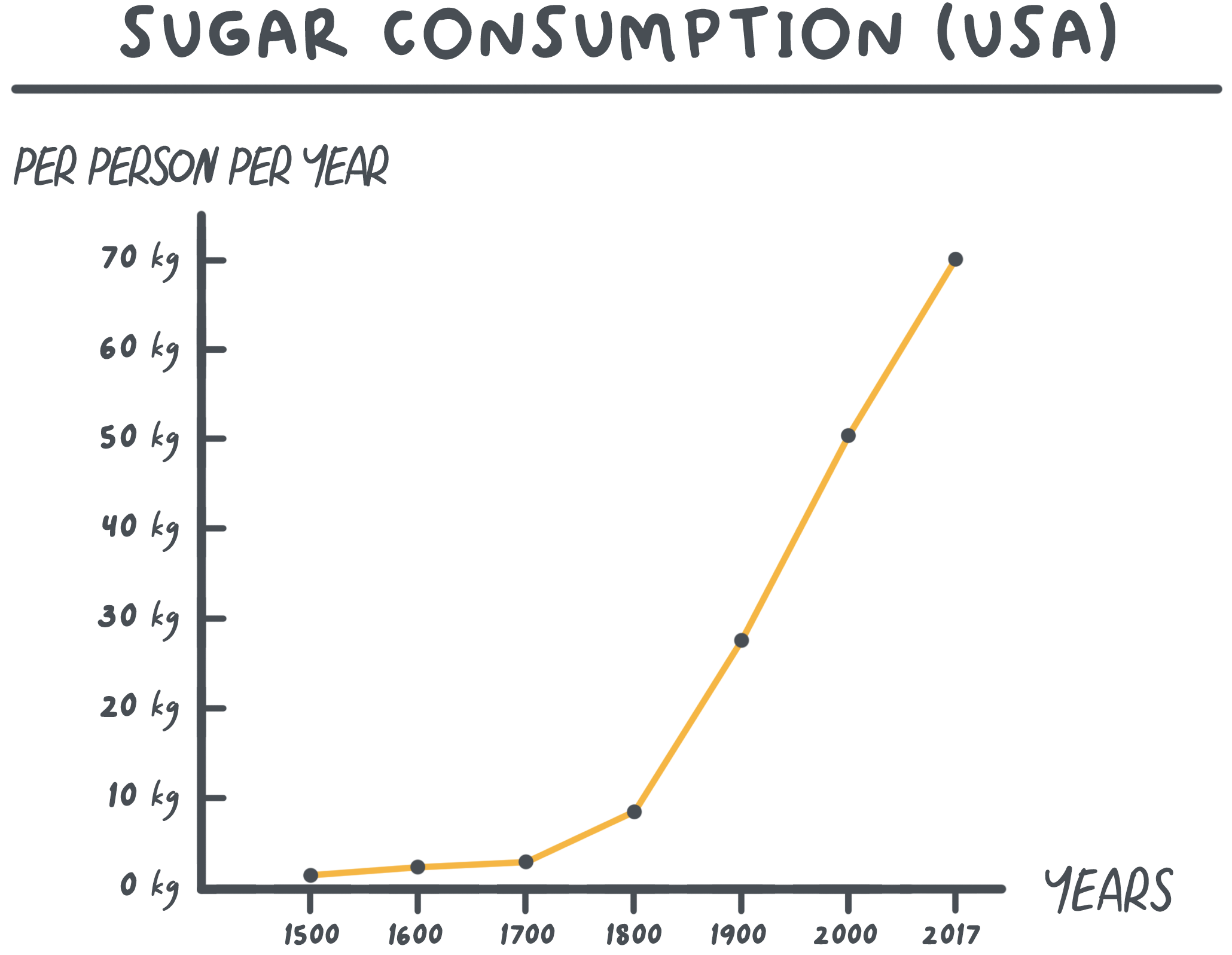
Addiction begins in utero, with similarities to fetal alcohol syndrome.8
Unlike other psychoactives, sugar doesn't kill appetite or detox the gut. Sugar is packed with non-nutrient calories that have caused the obesity epidemic. Other psychoactives, from caffeine to DMT to weed, don't have calories. Psychedelics aren't addictive. Sugar is a bad trip.9
Cultures that demonize psychoactive plants, from caffeine to alcohol, weed, and psilocybins, often end up with the psychoactive sugar/carb addiction. Mormons are such a group. They replaced morning coffee with soda and evening alcohol with sugary drinks and treats. Sugar is highly refined from its original plant form to heighten its rush and concentrate its effects, triggering the "reward center" just like nicotine, cocaine, heroin, and alcohol.10
Sugar addicts have a hard time giving up the substance for long enough to determine which inflammation symptoms have formed due to their habit (see Detox). So, most people are using culturally-acceptable inflammatory psychoactives.
With rhythmic rituals and psychedelics, you can break the sugar addiction, and other patterns. Data on psychedelics points to their ability to cure chronic inflammatory diseases, from depression to autoimmune disease.11
How?
Entheogens
En-theo-gens translates to "God within."
Entheogens are the category of psychotropic plant medicines that awaken higher consciousness without side effects.
These plant medicines are pro-social, known for inducing insight to evolve, get off autopilot and see a bigger whole. Entheogens alter perception for spiritual development, transcending a person's ordinary perspective on themselves and reality.
These psychoactives, found in mushrooms, cacti, tree barks, and in venoms, a non-plant source, were employed ritualistically for culturally-sanctioned visionary experiences. They are found in most ecosystems, where humans have grazed since we were hominids, and were used in just about all ancient religions and cultures.12 In his book, How to Change Your Mind, Michael Pollan points out that evolution didn't edit out humans on psychoactives.
Humans have respected the journey of the psychotropic experience for as long as we've been human. Archaeological records indicate the presence of psychotropic plants and drug use in hominids. Evidence suggests that psychedelics enhanced hominids social and cognitive evolution, including the development of ritual, laughter and storytelling.13
Research on terminal cancer patients has found that, with just one guided psilocybin experience (magic mushrooms), fear of dying and related anxiety and depression lifted. A recent study showed one psilocybin trip alleviating severe depression, with supportive psychotherapy, even a year later.14
Psychedelics, like intense yoga practices, lift the veil of the ego.
One trip.
When entheogens were criminalized, our culture lost sight of their value for seeing a bigger chunk of reality. Shamans from the Americas, and enlightened gurus from Asia, describe everyday life as an illusion, and a higher level of consciousness as the ability to see true reality. Ethnopsychologist Holgar Kalweit said it like this: "Shamanism is the door to the real world."15
Entheogens disrupt outdated habit patterns by stimulating neuroplasticity, emotional plasticity and psychoplasticity. "Plasticity" is the ability of a biological system (such as the nervous system and brain) to adapt and learn. Being able to absorb new information (becoming memory or stored learning); developing new skill sets and resilience: this is crucial today with our global epidemic of chronic emotional inflammation and neurodegeneration.
Chronic inflammation leads to depression. Depressed people suffer from negative affect, which causes an individual to get lodged in emotional distress: anxiety, sadness, fear, anger, shame, and other unpleasant emotions all maintain and exacerbate depression. A 2020 study showed that negative affect and depression could be reversed with just one guided trip with entheogens. One guided trip to have a better ride through life.16
How does it work? Let's look at DMT, a substance that is also generated by our own bodies.
DMT
DMT (N-dimethyltryptamine) is an endogenous hallucinogen that enhances perspective and brain plasticity. It is biosynthesized and metabolized in the brain and peripheral tissues. DMT researcher Steven A. Barker asks: "Why do humans produce hallucinogens in their brains?"17
DMT is produced in the pineal gland and cerebrospinal fluid (CSF), along with serotonin and melatonin. DMT is neuro-protectant, neuro-regenerative, and neuro-restorative (as are melatonin and serotonin). DMT is both hard security and the brain's clean-up crew for the CSF.
When people take a dose of DMT, say through the plant-based brew ayahuasca, it rewires the nervous system with lasting effect. DMT heals the brain by generating new brain cells, improving spatial learning and memory. Plus, there's no alcohol, sugar or overeating hangover, as DMT is non-addictive, rapidly metabolized, and non-toxic.18
What is clear is that humans evolved, both biologically and culturally, having visionary experiences. We are reliant on endogenous or exogenous DMT to uplevel our consciousness, see the bigger picture, and return to a more informed reality. We've legalized and manufactured en masse a toxic psychotropic, sugar, which is morphing our species in utero, while outlawing sacred plants that give insights into enlightened nature.
Hmm.
Be the hero on the journey. Receive your vision. Regenerate your mind.
Tips for Trip
I've sat multiple 10-day silent meditation retreats, meditating for 14 hours a day, and invested 6 hours on the yoga mat a day for weeks with gurus, and been guided through intentionally healing psychedelic ceremonies. I lead 3-day sober breakthrough experiences with dynamic groups and specific questions. All dismantle the mental afflictions, release addictions and outdated personalities, and reveal who you should become next.
"Set and setting," termed by Timothy Leary, describes how to prepare. "Set" is the mindset, or intention you bring to the journey or ceremony. "Setting" is the environment, the people, the place. Because you are intentionally affecting your perception, thinking, and coordination, you need to be in a safe, comfortable, supportive environment.
Michael Pollan points out that otherwise-obstructed insights and breakthroughs often come from asking the right question going into a trip. So, what is the right question for you to ask the universe right now, and what is the best way for you to take a trip into the unknown?
If you are interested in entheogens, know they are illegal in many places, despite their non-addictive nature. Entheogens and synthetics like MDMA are having a revival, both on the streets and in the laboratories, and we're seeing more legalization. Notably, more healers and therapists are guiding entheogen experiences. Don't take a mind-altering dose for the first time on your own. Microdosing, or experimenting with doses that don't have full-blown psychedelic effects, is a way to gain experience with how the substance affects you in a very low dose.
Because of the illegal nature of many entheogens, know your source. You can buy a drug-checking kit at Dancesafe.org. Dancesafe also supplies factual education literature on drugs from a peers-educating-peers perspective, as well as health and safety information. PsychonautWiki community has information on dosing and duration. Research on the websites may lead you to a guide.
The Hero
Anyone who goes on a spiritual journey must bring something back.19 Alan Watts
Your evolution requires a dying.
What dies?
Your beliefs.
You trip up your old ways of thinking.
You shake the pattern.
Light gets in.
You receive insight.
You can see the conversation between your subconscious and conscious in the liminal space.
In the experience, you release control, you surrender to the adventure, your conditioned mind dissolves and you see more of the whole. You've experienced a reality that wasn't previously available and that has changed you for the better. Your better path forward is revealed.
Notes
- Dave Gray. Liminal Thinking: Create the Change You Want by Changing the Way You Think. Rosenfeld Media, 2016. Permission to reproduce the diagram kindly given by the author.
- Joseph Campbell. The Hero with a Thousand Faces. Novato, Calif: New World Library, 2008.
- Lord Justin T. Chiodini Of Kilnaish Scotland. (2021, November 30). Terence McKenna Psychedelics As Catalysts Of The Imagination [Video]. YouTube. www.youtube.com/watch?v=xE2KpdlrOnY
- Babak Mohammadzadeh, et al. "Determining the Relationship Between Depression and Brain Waves in Depressed Subjects Using Pearson Correlation and Regression." International Journal of Epidemiologic Research, vol. 3, no. 4, 2016, pp. 376–85.
- Chanting: Junling Gao, et al. "The Neurophysiological Correlates of Religious Chanting." Scientific Reports, vol. 9, no. 1, 2019, p. 4262. doi:10.1038/s41598-019-40200-w; Dobrakowski, Paweł, et al. "Changes in the Electrical Activity of the Brain in the Alpha and Theta Bands During Prayer and Meditation." International Journal of Environmental Research and Public Health, vol. 17, no. 24, 2020, p. 9567. doi:10.3390/ijerph17249567; Fasting: Le Shi, et al. "Fasting Enhances Extinction Retention and Prevents the Return of Fear in Humans." Translational Psychiatry, vol. 8, no. 1, 2018, p. 214. doi:10.1038/s41398-018-0260-1; DMT: Christopher Timmermann, et al. "Neural Correlates of the DMT Experience Assessed with Multivariate EEG." Scientific Reports, vol. 9, no. 1, 2019, p. 16324. doi:10.1038/s41598-019-51974-4; Psilocybin: F. Tyls, et al. "PM506. Psilocybin Clinical Trial: Acute Effects and Its Relationship to the Brain Activity as Measured by Quantitative EEG." International Journal of Neuropsychopharmacology, vol. 19, Suppl_1, 2016, p. 84. doi:10.1093/ijnp/pyw041.506.
- Magalie Lenoir, et al. "Intense Sweetness Surpasses Cocaine Reward." PloS One, vol. 2, no. 8, 2007, e698. doi:10.1371/journal.pone.0000698.
- Guyenet Stephan. "By 2606, the US Diet Will Be 100 Percent Sugar." Whole Health Source, 18 Feb. 2012, wholehealthsource.blogspot.com/2012/02/by-2606-us-diet-will-be-100-percent.html.
- David A. Wiss, et al. "Preclinical Evidence for the Addiction Potential of Highly Palatable Foods: Current Developments Related to Maternal Influence." Appetite, vol. 115, 2017, pp. 19–27. doi:10.1016/j.appet.2016.12.019.
- David A. Wiss, et al. "Sugar Addiction: From Evolution to Revolution." Frontiers in Psychiatry, vol. 9, 2018, p. 545. doi:10.3389/fpsyt.2018.00545; Krebs, Teri S., and Pål-Ørjan Johansen. "Psychedelics and Mental Health: A Population Study." PloS One, vol. 8, no. 8, 2013, e63972. doi:10.1371/journal.pone.0063972.
- Marinda Risk. "Sugar Addictions Prominent in Mormon Culture." The Guardian, 5 Jun. 2018; Gary Taubes. "Is Sugar the World's Most Popular Drug?" The Guardian, 5 Jan. 2017.
- Caitlin Thompson and Attila Szabo. "Psychedelics as a Novel Approach to Treating Autoimmune Conditions." Immunology Letters, vol. 228, 2020, pp. 45–54. doi:10.1016/j.imlet.2020.10.001.
- Michael Winkelman. "Introduction: Evidence for Entheogen Use in Prehistory and World Religions." Journal of Psychedelic Studies, vol. 3, no. 2, 2019, pp. 43–62. doi:10.1556/2054.2019.024.
- J. M. Rodríguez Arce and M. J. Winkelman. "Psychedelics, Sociality, and Human Evolution." Frontiers in Psychology, 2021;12:729425. doi:10.3389/fpsyg.2021.729425.
- Stephen Ross. "Therapeutic Use of Classic Psychedelics to Treat Cancer-Related Psychiatric Distress." International Review of Psychiatry, vol. 30, no. 4, 2018, pp. 317–30. doi:10.1080/09540261.2018.1482091; Griffiths, Roland R., et al. "Psilocybin Produces Substantial and Sustained Decreases in Depression and Anxiety in Patients with Life-Threatening Cancer: A Randomized Double-Blind Trial." Journal of Psychopharmacology, vol. 30, no. 12, 2016, pp. 1181–97. doi:10.1177/0269881116675513; Davis, Alan K., et al. "Effects of Psilocybin-Assisted Therapy on Major Depressive Disorder: A Randomized Clinical Trial." JAMA Psychiatry, vol. 78, no. 5, 2021, pp. 481–89. doi:10.1001/jamapsychiatry.2020.3285; Gukasyan, Natalie, et al. "Efficacy and Safety of Psilocybin-Assisted Treatment for Major Depressive Disorder: Prospective 12-Month Follow-up." Journal of Psychopharmacology, vol. 36, no. 2, 2022, pp. 151–58. doi:10.1177/02698811211073759.
- Christian Rätsch. The Encyclopedia of Psychoactive Plants: Ethnopharmacology and Its Applications. Park Street Press, 2005.
- Brian E. Leonard. "Inflammation and Depression: A Causal or Coincidental Link to the Pathophysiology?" Acta Neuropsychiatrica, vol. 30, no. 1, 2018, pp. 1–16. doi:10.1017/neu.2016.69; Hofmann, Stefan G., et al. "Emotion dysregulation model of mood and anxiety disorders." Depression and Anxiety, vol. 29, no. 5, 2012, pp. 409–416; Barrett, Frederick S., et al. "Emotions and Brain Function Are Altered up to One Month After a Single High Dose of Psilocybin." Scientific Reports, vol. 10, no. 1, 2020, p. 2214. doi:10.1038/s41598-020-59282-y.
- Clayton Crockett. "Professor Talks DMT Research, Its Effects on You, And Possibly Your Faith." LSU Reveille, 13 Nov. 2012; Barker, Steven A. "N,N-Dimethyltryptamine (DMT), an Endogenous Hallucinogen: Past, Present, and Future Research to Determine Its Role and Function." Frontiers in Neuroscience, vol. 12, 2018, p. 536. doi:10.3389/fnins.2018.00536.
- Jose A. Morales-Garcia, et al. "N,N-dimethyltryptamine compound found in the hallucinogenic tea ayahuasca, regulates adult neurogenesis in vitro and in vivo." Translational Psychiatry, vol. 10, no. 1, 331, 28 Sep. 2020. doi:10.1038/s41398-020-01011-0.
- Alan Watts. Alan Watts, Spiritual Alchemy [Video]. YouTube, 22 Nov. 2021. www.youtube.com/watch?v=EqgEVHPUN_I
Does this resonate with you?
- You wish you had more time to unplug and design your next ideal schedule: your next purpose, your next habits, your next reality
- You want powerful, growth-focused relationships
- You're reconsidering your job, your partnership, your career, or your company
- You want a strategic approach to making bigger things happen in the world, and you're ready to stretch into someone you haven't been before
- You know you need to invest in a room of players from diverse backgrounds who are already thriving and know how to mastermind
- You want to experience the higher order that comes from next-level integrity with your investments, your time, your habits, your motherhood
- You want to leverage your assets and unique genius to design your future
- You want the skills, tools, and structures to reach your goals with the people in your life: partners, teams, family
You're a perfect fit for Club Thrive. We'll be waiting for you. We're in this together.
Cate Stillman & the community at clubthrive.global
Go deeper
This chapter is drawn from Cate Stillman's work on primal habits and whole-body health.
Primal Habits is the shorter read: the core habits, distilled.
Uninflamed is the longer, full-depth edition: every habit, the body types, the fasting guide, and the science.