
You've been quietly watching.
You've watched the AI tools multiply. You've watched the influencers churn out slop. You've watched conscious voices in your community critique the whole thing — the energy use, the environmental cost, the outsourcing of embodied wisdom to a machine. You've nodded along because those critiques feel right.
And you've kept your hands off.
But underneath the nodding, something else has been happening. You've watched your less-conscious peers lap you in reach. You've watched your competitors build funnels you don't understand. You've watched thought leaders you don't respect scale their message five times faster than yours. And a quiet voice inside you has started asking a question you don't want to answer:
What if abstaining from AI is a bigger integrity issue than using it?
This blog post is for the wellness pro, coach, healer, or holistic practitioner standing at the threshold of the AI revolution — with more caution than clarity, and more shame than strategy.
Let's name what's actually happening there.
Part 1
The AI Shaming Trap: Why Conscious Voices Are Being Silenced Right When They're Most Needed
In most conscious wellness communities, you're not just dealing with a technology adoption question — you're dealing with an unspoken virtue hierarchy that punishes engagement with AI. Think of the Purist as the version of you who wants to stay clean, embodied, and analog. And the Operator as the version of you who sees a tool that could 10x your impact if you learned it.
When you start to explore AI seriously, the Purist doesn't just critique — she shames. And the community around you often reinforces her, because your engagement threatens the shared story that "conscious people stay away from that stuff."
The messaging is layered:
- Environmental critique: "Look at the energy AI uses. Look at the water for cooling."
- Embodiment critique: "You're outsourcing your wisdom. You're losing your gut."
- Ethics critique: "AI is trained on stolen work. It replaces human labor."
- Aesthetic critique: "You can tell that content is AI. It has no soul."
Every one of these has a grain of truth. And every one of them, taken as a blanket permission slip to abstain, is silencing the exact voices that should be leading.
Because here's the arithmetic nobody wants to run:
The uninformed are already using AI at scale. Content mills. Ad farms. Grift funnels. Automated influencer accounts. The AI slop machine is already running full tilt — and it's mostly being driven by people whose values you probably don't share.
Your abstention doesn't slow that down. It doesn't recover the water. It doesn't reduce the energy load. What it does is reduce your voice's ability to compete with theirs.
"The judgment is largely coming from the uninformed. You can't save the planet by abstaining. What the bigger companies are doing is on such a ginormous scale that your little tiny recycling over here isn't going to make any difference."
The Purist's demand is that you stay clean. The world's need is that you stay relevant.
Choose carefully.
Part 2
The Anatomy of the Wellness AI Collapse Pattern
Most wellness pros circling AI adoption know what the resistance feels like, but they don't always see the deeper pattern.
Here's how the collapse usually shows up. You've been running your practice — coaching, healing, teaching — the same way for years. It mostly works. You have a following, a modest revenue, and a philosophy you believe in.
Then the environment shifts.
Government Rules Change
If any part of your income depends on Medicaid, insurance, licensure boards, or grants, the goalposts move without warning. The staffing model you built no longer fits. The reimbursement rate no longer covers costs. The service delivery method you specialized in is suddenly non-compliant.
Direct-to-Consumer Marketing Requires Skills You Don't Have
You realize you've never had to run a funnel, write a Meta ad, or build a lead pipeline. When your institutional support disappears, you're a wellness pro with 20 years of clinical wisdom and no idea how to reach the people who need you.
The AI Divide Widens
Meanwhile, less conscious practitioners with fewer credentials are running Claude-generated funnels, writing three long-form pieces a week, launching six digital products a quarter, and scaling reach through automated systems you don't understand.
The Body Rebels
You start doing 12-hour days trying to keep up manually. Nervous system dysregulation. Sleep loss. The compulsive scroll of "how are they doing this?" Your body knows something has to change before you can.
The Integrity Rub Becomes Unbearable
You feel the specific ache of watching wisdom you've earned over decades reach fewer people than a 25-year-old with a Claude subscription and no ethics. Every hour spent doing manual work you know AI could handle costs you a little more than it did last quarter.
If you don't act, the market acts on you.
"If you don't make the cycle change yourself, life will make it for you."
Better to build an AI operating system on your own terms — with your own guardrails, your own integrity, your own voice — than to be forced into a rushed adoption when your income collapses.
Part 3
The Four Stages of the Conscious Operator's Journey
You don't go from "I don't touch that stuff" to "I've built an AI operating system that runs my mornings" in one weekend workshop. There are stages.
Stage 1
The Resistance (The Purist Speaks)
This is the philosophical stage. You've heard about AI. You've maybe played with ChatGPT once, felt weird, and closed the tab. Your community's stance is anti-AI, and yours is too — but the position feels more defensive than examined.
You notice: reflexive judgment when peers mention Claude. Vague guilt when you consider trying it. A quiet fear that engagement will change you in ways you can't undo. Superiority when you scroll past AI-generated content ("You can tell.")
What helps: Label it. This is the Purist's voice, not the truth. Get honest about what you're actually afraid of. Read one AI critique from a source you trust, and one AI defense from a source you trust. Notice which arguments hold up under scrutiny and which fall apart. The point isn't to become AI-forward yet. It's to stop reacting and start thinking.
Stage 2
The Exploration (The Slop Discovery)
You crack. You try Claude, ChatGPT, or Perplexity. You ask it to write something, and it does. You feel a small thrill and a small revulsion at the same time.
Then you generate a lot. Blog drafts. Email sequences. Course outlines. Ad copy. Fifty builds in a month, if you're a quick-start type. And you notice: most of it is slop.
The prose is flat. The insights are generic. The voice doesn't sound like you. A colleague or member points it out gently ("This doesn't feel like your writing"). And you feel the burn of having flooded your channels with output that damages your credibility.
"I really did a hard stop. I had to get a handle on what was going on. That's why I built the Command Agent. I had to create guardrails for myself. I had to create an organizational structure within my operating system, within myself."
This is the slop reckoning. And it's not a sign that AI doesn't work. It's a sign that you were using it without constraints.
The Purist rushes back in: "See? I told you." Don't listen. The slop problem isn't the AI. It's the missing systems layer between you and the AI.
Stage 3
The Constraint Layer (Systems Lord Emerges)
This is where the real work happens — and where most conscious wellness pros give up too early.
You stop hyper-generating and start designing. You build a Command Agent that runs your morning: pulls your top three priorities, your financial snapshot, your funnel status, your calendar for the day. You build one small guardrail at a time. You constrain AI to your voice by uploading your writing samples, your core frameworks, your ethical non-negotiables.
You stop asking AI to think for you and start asking it to protect your best thinking from your worst impulses.
In practice:
- You build a financial machine that shows you the numbers you've been avoiding
- You build a curriculum catalog that surfaces the IP you've forgotten you already have
- You build a policy layer that upholds the standards you keep breaking for yourself
- You build one integrated agent per week — not fifty in a month
The Purist's voice quiets. Not because she was wrong, but because you've addressed her real concern — integrity — through the design of your system, not through abstention from the tool.
Stage 4
The Conscious Operator (Impact Multiplied)
This is the stage where AI adoption stops feeling like a betrayal of your values and starts feeling like the amplification of them.
Your voice reaches further. Your ideas land in more hands. The wisdom you've spent 20 years earning finally travels at the speed of the technology available to distribute it. And crucially, you're still the one making the calls that matter: the ethical calls, the discernment calls, the "does this actually serve" calls.
You've become the Conscious Operator. Not the AI Purist. Not the AI Grifter. The third thing — the wisdom keeper who learned the tools and refused to abandon her integrity in either direction.
This is the archetype the wellness world desperately needs — and the archetype almost nobody is training you to become.
Part 4
Slop vs. Integrity: The Litmus Test
Because you are self-aware, you'll eventually ask: "Am I actually building with integrity — or am I just producing more slop with better branding?"
Here's a simple litmus test.
You Are Building with Integrity If:
You feel the friction: quiet doubt about whether a piece sounds like you, honest self-audit before publishing, willingness to throw away builds that don't hold up. You catch yourself when you're moving too fast and slow down before you publish, not after.
Integrity looks like: uploading your voice samples so Claude can match your rhythm, not just your topics. Reading every AI-generated piece out loud before sending. Deleting the version that sounds like a LinkedIn influencer even when it took you three hours to generate. Naming your ethical non-negotiables in writing and building them into your system prompts.
Integrity looks like Sara Sherman auditing her own overgeneration pattern, spotting the slop before her community had to, and building the Command Agent as a personal guardrail before it hurt her practice.
You Are Producing Slop If:
You've launched the "new AI-powered thing" but you can feel the flatness. Your engagement drops. Your closest members mention it gently. You justify the volume by pointing to reach metrics that don't correlate to real transformation.
Slop looks like: shipping content faster than you can quality-check it. Using AI to say more instead of using AI to say better. Copying frameworks from other coaches because Claude can generate the same shape. Losing your own voice because you stopped using it to think and started using AI as your default thinking layer.
A helpful question when you're not sure: "If someone who knew my work well read this piece cold — would they recognize me in it, or just recognize an AI-generated version of a coach who sounds like me?"
If they'd recognize you, you're building with integrity. If they'd recognize a generic archetype, you're producing slop.
Part 5
Integration Tools
Build Your Command Agent: A Starter Prompt
The single highest-leverage AI build for any wellness pro is a daily Command Agent — the guardrail that runs your morning and keeps you from opening 12 threads before you've even set your priorities.
Here's a starter prompt you can adapt (paste into a new Claude project you name "Command"):
You are my Command Agent. Every time I open you, greet me and then do the following, in order:
1. Ask me what day it is and pull my top three priorities for today based on my current active projects.
2. Give me a one-line financial pulse (based on the numbers I've shared in this project).
3. Give me a one-line funnel pulse (based on the current lead sources I've shared).
4. Ask me if there is anything from yesterday that needs to close out before I start today.
5. Only after all four of the above, ask what I want to work on next.
Non-negotiables: You will never open new threads or projects for me without asking. You will never assume context I haven't given you today. You will always ask before generating long-form output.
The point isn't the exact prompt. The point is that your AI system starts with a constraint, not with generation. That single reframe changes everything.
AI Coach Prompts: Using Claude as a Shadow Coach for Slop Detection
Once you have a Command Agent, here are three prompts to use as weekly quality checks:
Prompt 1 — Voice Audit
"Below are three pieces of content I published this week. Below those are three pieces of content I wrote 3+ years ago before AI. Compare them. Where has my voice weakened? Where does the recent work sound generic, coach-y, or AI-generated? Be specific and honest. Do not soften."
Prompt 2 — Overgeneration Diagnosis
"Here is a list of every build, agent, funnel, and piece of content I created this month. Group them into: (1) genuinely serving my mission, (2) probably slop I should retire, (3) worth refining. For each item in group 3, name the specific edit that would move it into group 1."
Prompt 3 — Constraint Layer Design
"I keep breaking my own policies with members, breaking my own writing standards, and breaking my own boundaries around AI-generated output. Design a constraint layer of three specific rules I can encode into my Command Agent that would automatically prevent me from breaking them. Make them specific enough that a virtual assistant could enforce them."
Use these weekly. Bring the raw pages of what you actually produced — not the sanitized story you tell yourself about it — and let the mirror reflect the pattern before your community has to.
Part 6
Your Heal Badge, Your Future You
If you're a wellness pro standing at the AI threshold — with more caution than clarity, and more shame than strategy — you are not failing your values. You are being asked to update them.
Inside Club Thrive, your Heal Badge is the first work most conscious operators do — before the funnel, before the agent, before the launch. Because until your nervous system settles around AI adoption and your integrity architecture reorganizes around Systems Lord constraints, no external tool will hold.
Your healing changes the entire fractal: your future decades of reach, your energy expenditure, your embodied wisdom's ability to travel, your capacity to compete with less conscious voices without losing your soul.
Take the Future You Quiz
See the trajectory you're on — given your current relationship with AI, your current constraints, and your current voice — and where a few key shifts could open more reach, integrity, and sovereignty.
References
- Bowen Family Systems concepts on differentiation and emotional cut-off, adapted here to community identity and belief system pressure
- Ayurvedic Dharma — the principle that healthy tissues uphold their own integrity, applied to business systems and policy
- Kolbe A Index research on quick-start vs. follow-through personality types and the specific constraint layers each requires
- Pareto's Principle (the 80/20 rule), applied here to build prioritization and slop reduction
- Referenced AI tools: Claude Cowork, Claude Code, Terminal, Perplexity, Plaud
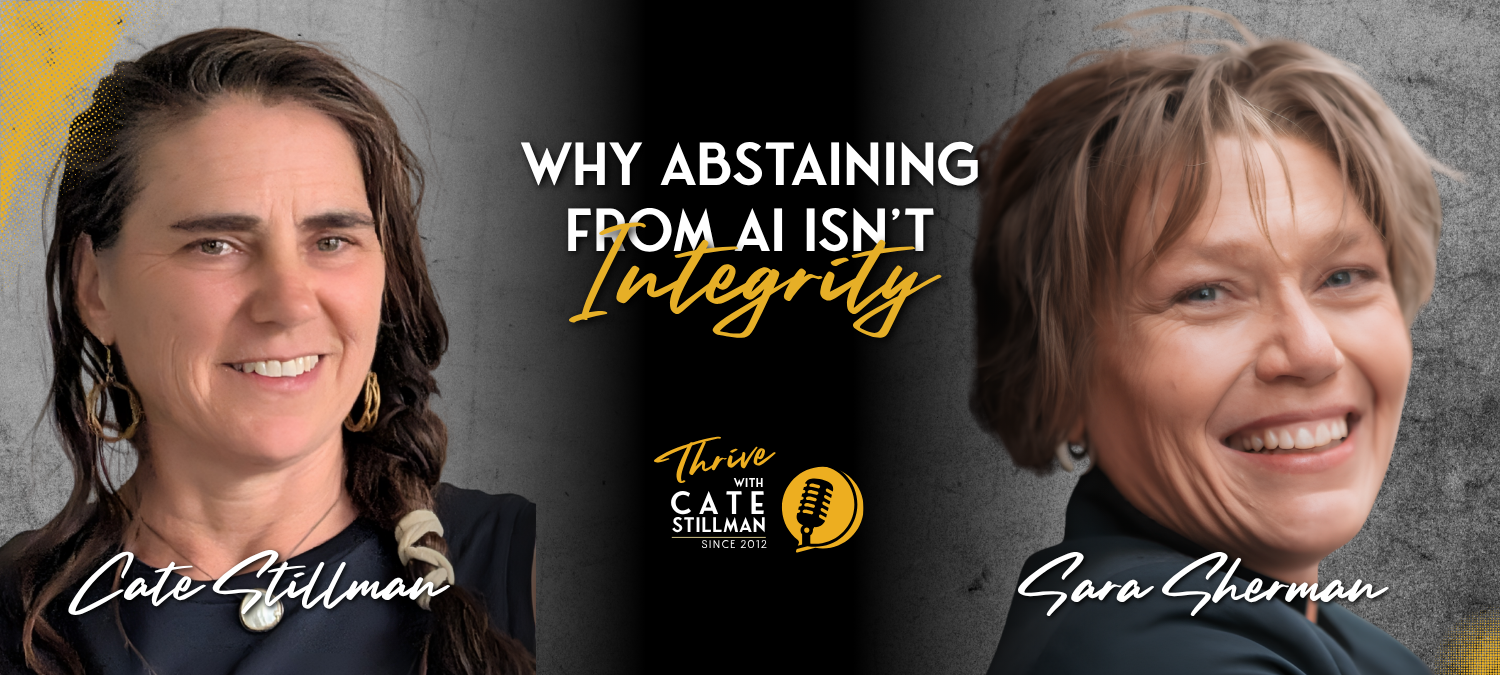
- Referenced conversation between Cate Stillman and Sara Sherman (Dandelion Family) on the Thrive with Cate Podcast
- Alex Hormozi's Vantage Mastermind — where both women study AI-forward business systems
- Ruben Hasid on Substack — recommended AI newsletter for non-developers
- Company of One by Paul Jarvis — foundational text on small-not-scale business design
- Club Thrive Global internal lexicon: Conscious Operator, Command Agent, Systems Lord, Slop Reckoning, Constraint Layer, Heal Badge, Future You, Sacred Ambition
- Club Thrive scorecard ecosystem, including the Future You Quiz