
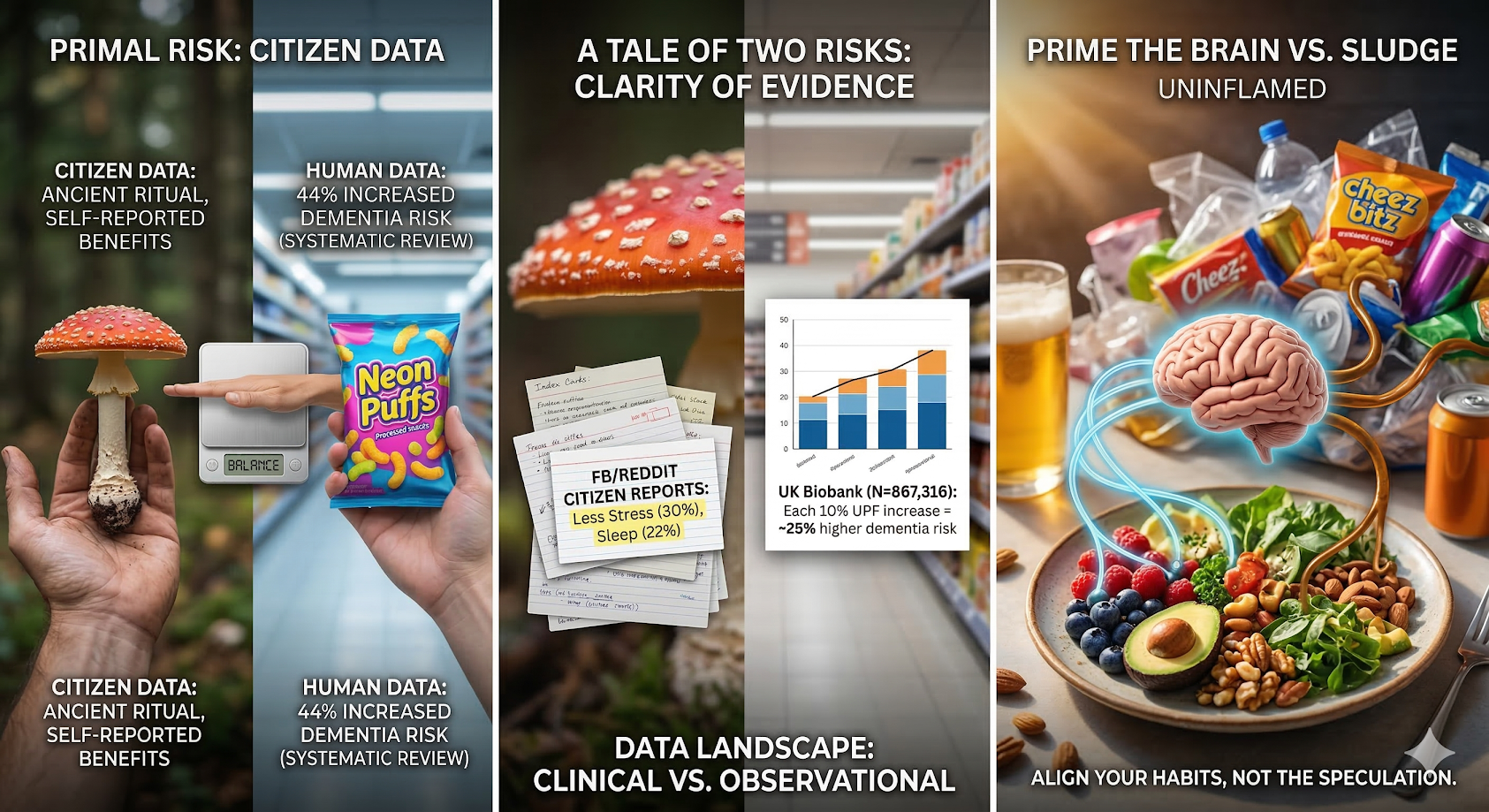
PRIMAL Brain Risk: Amanita Citizen Data vs. Processed Food Dementia

What happens to the human brain when we play with primal poisons and modern processed “food”?
In UNINFLAMED I argue that we’re not just inflamed in our tissues; we’re inflamed in our stories. We fear red‑capped mushrooms we hardly understand, yet we normalize an ultra‑processed diet that quietly erodes cognition, mood, and memory over decades. When you actually look at the human data on Amanita muscaria—and then lay it next to the human data on ultra‑processed food and dementia—a much more nuanced picture emerges.
1. What the clinical data on Amanita actually say
Modern medicine mostly meets Amanita muscaria in emergency rooms and poison centers.
Case reports and small series
Case series of two elderly spouses:
- A 75‑year‑old man with diabetes and chronic obstructive pulmonary disease ate one cap of presumed A. muscaria, developed hallucinations and lethargy, required intubation, and recovered [source].
- His wife, with similar comorbidities, also became drowsy and confused but recovered with supportive care [source].
- In both cases there was no mycological or toxin confirmation; diagnosis relied on history, mushroom appearance, and syndrome.
“Deceptive mushroom” case: a middle‑aged forager developed vomiting, confusion, and agitation after eating wild mushrooms identified clinically as A. muscaria; the report describes full recovery with supportive care but again lacks lab confirmation of ibotenic acid or muscimol.
CDC MMWR cluster: several community members in Minnesota developed nausea, vomiting, confusion, and drowsiness after a communal dish of mushrooms described as A. muscaria; identification was based on appearance and local mycologist, not toxin levels.
Taken together, these reports show:
- A recognizable neuropsychiatric toxidrome—confusion, agitation or lethargy, dyscoordination, sometimes seizures or coma—usually resolving with supportive care [source].
- Occasional severe outcomes, including ICU stays and rare fatalities, often in older adults with comorbidities and unverified doses [source].
- A consistent methodological gap: no randomized trials, and in many cases no confirmed toxin analysis; causality is strong but not laboratory‑proven in every instance.
These are not nothing; they are also not the same as saying, “We have definitive human data that any amount of Amanita is categorically brain‑poison.”
2. What the positive citizen data say
If you only read medical journals, you see the tail of the distribution: the people who end up in the ER. If you step into Amanita communities, you see something else: large numbers of people reporting perceived benefits, alongside manageable, self‑limited side effects.
Pro‑Amanita Facebook survey
A 2023 study scraped comments from Facebook groups where people intentionally use A. muscaria products. Among 250 users who gave clear reasons for regular use, people most often reported:
- Less stress (about 30%).
- Better sleep / fewer insomnia symptoms (about 22%).
- Reduced depressive symptoms (about 20%).
- Reduced pain (about 18%).
- Some mentioned improvement in intestinal symptoms (about 4%).
Limitations: Participants self‑selected into “pro‑Amanita” spaces; no independent verification of mushroom species, preparation, or dose; no control group or prospective follow‑up. But the pattern is clear: people who are actually using Amanita regularly report nervous‑system, mood, pain, and sleep benefits, not just toxicity.
Reddit thematic analysis
A 2024 analysis of nearly a thousand posts and over nine thousand comments on r/AmanitaMuscaria found: Users report more positive than negative outcomes overall, with adverse effects described as mostly minimal and self‑limiting at typical “micro” or low doses. The most common positives match the Facebook data: relaxation, anxiety reduction, sleep support, pain relief, mood shifts, vivid dreaming, and “mental resets.”
Again: uncontrolled, anonymous, unverified—but this is the same type of citizen data we quietly accept in other domains (e.g., side‑effect reporting for many drugs and vaccines).
Ethnographic memory
Ethnographic work with Siberian Koryak and neighboring peoples shows A. muscaria as a rare, ritual sacrament and occasional remedy—not a staple food, but a shamanic tool tied to myth, seasonal rhythms, and careful preparation. They placed it inside taboo and training, not on an endcap at Whole Foods.
3. Mechanism snapshot: why it’s powerful at all
- Ibotenic acid is structurally similar to glutamate; it can act as an excitotoxin and is used in animal research to create targeted brain lesions.
- Muscimol is a potent GABA receptor agonist; in animals it reduces seizure activity and can attenuate ischemic brain damage, suggesting context‑dependent neuroprotective potential [source].
In simple terms: Amanita carries both a strong gas pedal and a strong brake pedal for the brain. We have preclinical hints of benefit and clear clinical hints of risk—but no controlled human trials that tell us how to dose, for whom, under what conditions.
4. The processed‑food brain experiment
Now contrast that with the data on ultra‑processed food and dementia.
Large‑scale human studies
- A 2024 systematic review and meta‑analysis of 10 observational studies (867,316 adults) found that high vs. low ultra‑processed food intake was associated with a 44% increased risk of dementia.
- A UK Biobank analysis reported that each 10% increase in ultra‑processed food consumption was linked to about 25% higher risk of overall dementia, even after adjusting for age, sex, education, and lifestyle factors.
- Another study found that among people younger than 68, each extra daily serving of ultra‑processed food increased Alzheimer’s risk by 13%; eating ≥10 servings/day vs. <10 daily servings nearly tripled Alzheimer’s risk.
This isn’t speculative; it’s big‑N, prospective data replicated across cohorts.
Mechanisms of ultra‑processed neurotoxicity
These studies are backed by plausible mechanisms: Chronic glycemic and insulinemic spikes → insulin resistance → higher dementia risk. Emulsifiers, sweeteners, oxidized oils, and additives disrupting the gut barrier and microbiome, increasing neuroinflammation through the microbiota–gut–brain axis. Displacement of polyphenols, omega‑3s, minerals, and vitamins that support synaptic plasticity, myelination, and nitric‑oxide‑mediated vascular health—all themes you develop in UNINFLAMED under MICROBIOME, NITRIC OXIDE, and FAST.
If Amanita represents a rare, acute gamble with the brain’s GABA/glutamate systems, ultra‑processed food represents a daily, chronic gamble with our vascular, metabolic, and inflammatory terrain. And only one of these gambles has strong human evidence behind it.
5. Reframing “danger” through an UNINFLAMED lens
In UNINFLAMED and the PRIMAL HABITS you already teach a different way to assess risk:
- TRIP – consciously crossing thresholds for insight, not to escape life.
- FAST & ADIPOSE – using fasting rhythms to clear neuroinflammatory load and heal adipose‑brain signaling [source].
- MICROBIOME & nitric oxide – designing the nasal, gut, and vascular microbiome so the brain lives in an oxygen‑and‑NO rich environment, not a processed sludge [source].
- SILENCE, SLEEP, OUTSIDE – moving brainwaves out of chronic beta into alpha, theta, delta for repair and integration.
Seen from that map:
Amanita is a high‑voltage, poorly mapped plant ally that some people are already using to nudge TRIP, SLEEP, and nervous‑system tone. We have thin clinical data on harm and thin citizen data on benefit. It belongs, if at all, under strict ritual, careful preparation, and informed consent—not as a casual “gut reset.”
Ultra‑processed food is a low‑voltage, omnipresent input with strong clinical data on long‑term brain harm and almost no compensatory benefit. It actively sabotages every PRIMAL HABIT you teach—FAST, MICROBIOME, FOCUS, SLEEP, PURPOSE—day after day.
So the honest risk story isn’t “Amanita is pure poison, modern food is safe.” It’s:
- Amanita muscaria is a powerful, under‑studied sacrament showing both real toxicity and perceived benefits in uncontrolled human use.
- Ultra‑processed food is a powerful, over‑consumed product line showing clear, dose‑dependent brain damage in large human cohorts.
6. Where this leaves a PRIMAL person
For Club Thrive and our community, a sane hierarchy looks like this:
Non‑negotiables for brain health
- Dramatically reduce ultra‑processed foods; build your diet around whole plants, clean fats, and microbiome‑supportive fibers and polyphenols.
- Anchor your day in PRIMAL HABITS: FAST, MICROBIOME, SILENCE, SLEEP, OUTSIDE, FOCUS, FORGIVE, PURPOSE—the core of UNINFLAMED.
If you’re curious about sacraments
- Prioritize plant teachers with emerging controlled human data (psilocybin, for example) and strong therapeutic containers.
- Treat A. muscaria as a high‑risk, low‑data ally; acknowledge both toxicology reports and citizen‑reported benefits, and do not frame it as a proven neuro‑healer or gut‑reset tool.
Always ask
- What is the quality of the evidence behind this fear?
- What is the quality of the evidence behind this normalization?
When you align your habits with the evidence and with the PRIMAL architecture from UNINFLAMED, you stop being a passive subject in someone else’s experiment—whether that’s a red cap in the forest or the beige food on every aisle.
To know more click here to join my SKOOL community.