
Serpents, Red Caps, and the Central Channel: Re‑mything Eden with PRIMAL Habits

1. When the serpent was still holy
Before Genesis turned the serpent into a liar and Eve into a problem, the Near Eastern world was full of stories where snakes meant wisdom and trees meant direct access to the divine.
In Mesopotamian myths and early iconography, humans sit beside a sacred tree with a serpent between them, reaching for fruit that symbolizes knowledge and life. The serpent is a boundary‑crosser—moving between earth and underworld, shedding skin, mediating power. The tree is the axis mundi, the living pillar that connects underworld, earth, and sky.
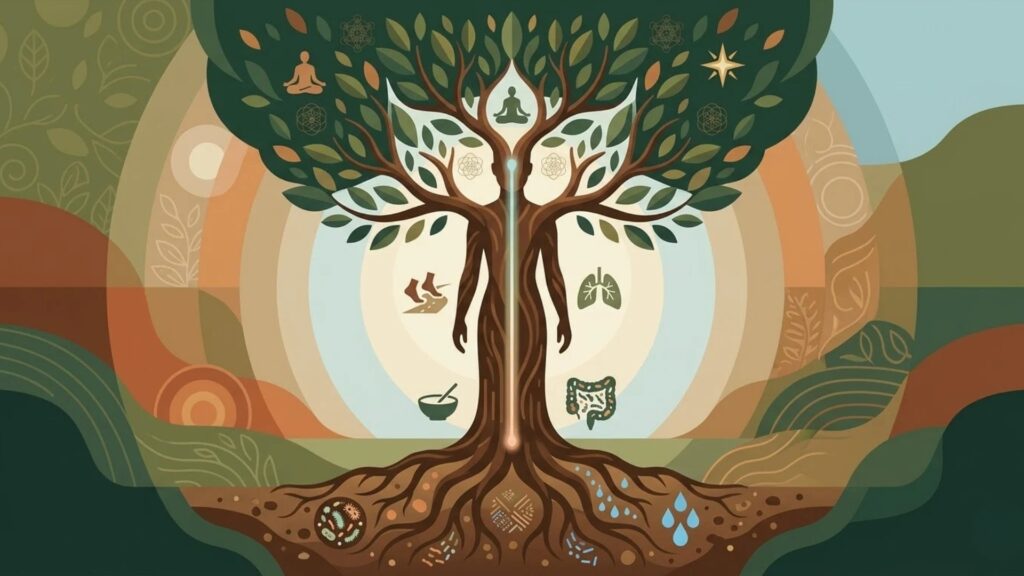
In yogic language, that serpent is kundalinī and that tree is your suṣumnā nāḍī—the central channel of the subtle body. Kundalinī is the coiled potential at the base of the spine. Suṣumnā is the midline through which that energy rises, connecting mūlādhāra (root) to sahasrāra (crown). When you experience subtle enlightenment states—whole‑body shivers, light in the spine, spontaneous reorganizing of your life—that’s the “snake” moving up the tree.
The genius (and the violence) of the Adam & Eve edit is that it takes that architecture and flips its meaning:
- The snake goes from sacred inner current to external tempter.
- The tree goes from living conduit to forbidden object.
- Feminine curiosity (śakti rising) becomes the original sin instead of the original awakening.
PRIMAL work begins by restoring the old reading: your body is the tree, your kundalinī is the serpent, and your direct experience is not a threat to God; it’s how God happens.

2. Amanita at the root of the tree
Enter Amanita muscaria: the red‑capped mushroom that sits under evergreens in European art and under goddess stories in Siberia.
In Siberian traditions, A. muscaria was a rare, ritual sacrament. Shamans and sometimes elders ingested carefully prepared caps to alter consciousness, seek insight, and mediate between human and spirit worlds. The mushroom grew at the root of the forest’s “world tree,” and its effects were interpreted as the tree and serpent inside the body waking up.
Modern evidence is messy but revealing:
- Clinical case reports show that high, poorly measured doses—especially in elders with comorbidities—can trigger confusion, agitation, stamina collapse, even coma. Most recover with supportive care; rare fatalities occur.
- Many of these cases lack lab confirmation of the mushroom or specific toxins; they’re clinical judgments based on story and appearance.
- On the other side, large online communities of intentional users report perceived benefits at very low doses: less anxiety, better sleep, reduced pain, deeper dreaming, a kind of “heavy‑body, quiet‑mind” sedation that feels more like GABA than like classic psychedelics.
Pharmacology explains the polarity: ibotenic acid has excitotoxic properties in animal brains; muscimol is a powerful GABAAA agonist. Together, they can slam the nervous system between excitation and deep inhibition. That’s not inherently “good” or “bad.” It’s voltage.
From a PRIMAL view, Amanita is emblematic of a whole category of plant allies:
- Deeply woven into pre‑patriarchal myth.
- Powerful enough to warrant strong taboos and skilled handling.
- Too wild and decentralizing to survive comfortably inside monotheistic or biomedical control systems.
You don’t have to drink it to learn from it. You can let it remind you that there was a time when our ancestors risked rare thunderbolts of altered consciousness in service of the tribe, not private consumption.

3. Kundalinī, suṣumnā, and the PRIMAL tree
In UNINFLAMED you sketch the same architecture with different language:
- TRIP as scheduled threshold‑crossing—fasting, pilgrimage, entheogens, deep practice—to loosen the ego and expand the map.
- MICROBIOME and nitric oxide as the soil and sap that nourish the nervous system’s branches.
- FAST, OUTSIDE, WALK/RUN/CRAWL as ways of restoring the body to the ecosystem so the “tree” can re‑root into real earth.
- SILENCE, FOCUS, PURPOSE, FORGIVE as the pruning, wiring, and alignment practices that keep the central channel clear instead of kinked.
In yogic anatomy:
- Suṣumnā is the subtle version of the spine.
- Iḍā and piṅgalā spiral like serpents around it, crossing at each chakra.
- Kundalinī is the dormant potential at the base that can ascend when the channel is clear, bringing waves of insight and reorganization.
Genesis says: “Do not eat from that tree. Do not listen to that serpent. Do not trust that feminine impulse to know for yourself.”
PRIMAL HABITS say: “Clean up the roots. Breathe the branches. Let the serpent rise in a body and ecosystem that can hold it.”
That’s what svādhyāya and sva‑stha really are:
- Svādhyāya – self‑study, not just of scriptures but of this organism: your patterns, cravings, fears, and flashes of grace. Watching how your nervous system responds when you FAST, when you TRIP, when you stop scrolling and walk into the sunrise.
- Sva‑stha – being established in one’s own self, your own authority. Not ego‑rebellion, but stability: you become the tree, not the leaf blowing between dogmas.
When kundalinī actually moves, it doesn’t ask a priest’s permission. It asks: is the channel clear? Is the body ready? Is there community, guidance, and MICROBIOME support for what comes next?

4. The patriarchy problem: who gets to move the serpent?
Once you see the pattern in Genesis, you see it everywhere:
- Entheogens recoded from sacraments to contraband.
- Women’s bodies recoded from oracles and healers to sources of temptation and shame.
- Forests recoded from temples to timber.
- Direct experience (svādhyāya) recoded from valid knowing to “subjective” or “hysterical.”
The common thread is control of the central channel:
- If serpent energy rises freely, people have their own visions. They may question empire, war, toxic work, or extraction.
- If the “tree” is deeply rooted in local ecology, people are loyal to watersheds and non‑humans, not just to flags and brands.
- If svādhyāya and sva‑stha are normal, people are harder to gaslight about their bodies, their kids, or their land.
Patriarchal, top‑down systems—religious or corporate—work better when:
- TRIP is discredited (“drugs,” “madness,” “witchcraft”).
- Silence is filled with broadcast and notifications.
- The MICROBIOME is colonized by antibiotics, processed food, and chemical exposure.
- FAST is pathologized (“starvation mode”) and constant consumption is ideal.
In that light, the demonization of serpent, tree, and Eve looks less like “divine revelation” and more like early narrative infrastructure for control.

5. Re‑installing the PRIMAL operating system
You don’t fix this by simply going back to paganism or romanticizing Amanita. You fix it by rebuilding the conditions in which real kundalinī experiences are safe and meaningful:
- Clear the roots (MICROBIOME, FAST)
- Eat in a way that feeds microbial diversity and nitric oxide, not chronic inflammation.
- Use fasting and circadian alignment to burn old trauma and make space in adipose and fascia.
2. Strengthen the trunk (WALK/RUN/CRAWL, REST)
- Build a stable, responsive body with real movement, real rest, real contact with ground.
- Think of suṣumnā as needing literal myelin, collagen, and mineral density.
3. Quiet the crown (SILENCE, FOCUS, SLEEP)
- Reclaim evenings and mornings as sacred technology.
- Let alpha/theta states return through meditation, chanting, breath—your endogenous psychedelics.
4. Aim the serpent (TRIP, PURPOSE, FORGIVE)
- If and when you use exogenous TRIP tools (from breathwork to psilocybin where legal to, for some, Amanita), do it inside a held ritual with integration.
- Anchor the insights into PURPOSE and FORGIVE so the energy doesn’t just blow out your circuits but rewires your life.
In that ecology, kundalinī rising is not pathology. It’s a system‑level re‑orientation back to life.
6. Where Amanita belongs—for now
Given all this, a sane position on Amanita looks like:
- Respect – acknowledge its place in ancestral myth as a doorway plant at the base of the tree.
- Honesty – we do not yet have controlled human trials linking it to stable improvements in brain health, microbiome status, or trauma resolution; we do have both serious adverse events and many self‑reported benefits at low doses.
- Context – it should not be another lonely supplement in an isolated modern nervous system. If it is used, it should be in the context of PRIMAL HABITS already in place: clear roots, strong trunk, quiet crown, relational container.
Most people don’t need Amanita to re‑myth Eden. They need to stop outsourcing serpent energy and tree wisdom to old stories that said “no” and new systems that say “buy.”
7. Sva‑stha in the Anthropocene
Ecological destruction is what happens when an entire species forgets it is a forest, not a factory.
Re‑installing serpent + tree + PRIMAL HABITS is not just a personal wellness project. It’s species‑level course correction:
- A human in sva‑stha—established in their own authority, nervous system regulated, TRIP integrated—is far less likely to participate in the destruction of their watershed for convenience.
- A culture that honors subtle kundalinī experiences and plant‑mediated insight is more likely to listen when the forest says “enough.”
- A network of such humans can act like mycelium—distributing information and resources in ways top‑down systems can’t anticipate.
That’s the real “forbidden fruit” now: not a mushroom or a myth, but the lived experience of being a stable tree with a conscious serpent inside—plugged back into a living earth, guided by svādhyāya, and no longer needing permission to know.
To know more click here to join my SKOOL community.
Leave a Reply